
Doberman Pinscher: Your Complete Guide
The Doberman Pinscher is one of the most intelligent, loyal, and athletic dog breeds in the world. Recognised for its sleek build and confident presence, this powerful working dog has become a popular companion in Australia and across the globe.
But the Doberman is far more than a guard dog.
For active families, experienced breeders, and dedicated dog owners, the Doberman Pinscher can be an extraordinary Doberman Pinscher companion — when properly trained and cared for.
This complete guide covers everything you need to know about the Doberman Pinscher dog breed, including history, temperament, health, training, care, and whether this breed fits your lifestyle in Australia or worldwide.
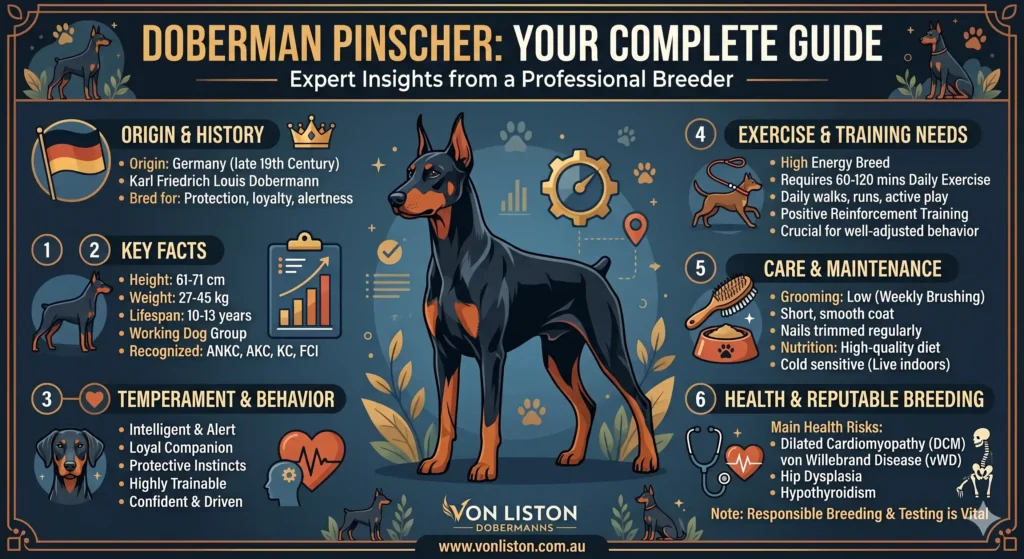
History of the Doberman Pinscher
The Doberman originated in Germany in the late 19th century. Karl Friedrich Louis Dobermann, a tax collector, wanted a protective yet loyal companion while working. Through selective breeding — likely including Rottweilers, German Pinschers, Greyhounds, and Weimaraners — he developed the Doberman Pinscher.
The breed quickly gained recognition for:
- Personal protection
- Police and military work
- Search and rescue
- Competitive obedience
Dobermans in Australia
Dobermans are officially recognised by the ANKC Dobermann Breed Standard and are not listed as restricted breeds in Australia.
Across Australia — from Sydney and Melbourne to Brisbane and Perth — Dobermans are valued as family companions, working dogs, and show competitors.
Doberman Characteristics
The Doberman is known for its balance of strength and elegance.
Physical Traits
- Athletic, muscular frame
- Deep chest and defined musculature
- Short, glossy coat
- Alert expression
Because of their short coat, Dobermans are relatively low-shedding and easy to groom. However, they are sensitive to cold climates and should live indoors.
In warmer Australian states (QLD, WA, NT), they tolerate heat reasonably well but require shade and hydration during exercise.
Doberman Temperament
The Doberman temperament is intelligent, loyal, and protective — yet emotionally sensitive.
A well-bred Doberman is:
✔ Confident
✔ Highly trainable
✔ Devoted to family
✔ Alert without unnecessary aggression
✔ Energetic and driven
However, Dobermans are not suitable for neglectful ownership. They require:
- Daily mental stimulation
- Consistent leadership
- Socialisation from puppyhood
They form strong attachments and can develop separation anxiety if left alone for long periods.
Are Dobermans Good Family Dogs?
Yes — when properly socialised and trained.
Dobermans can be:
- Gentle with children
- Protective guardians
- Loyal companions
- Playful and affectionate
However:
- Supervision is recommended with young children
- Early socialisation is critical
- Temperament depends heavily on responsible breeding
For active Australian families and experienced global owners, Dobermans can integrate beautifully into home life.
Doberman Exercise Requirements
Dobermans are a high-energy working breed.
They require:
- 60–120 minutes of daily exercise
- Structured training sessions
- Mental enrichment activities
Ideal activities include:
- Long walks or runs
- Agility training
- Obedience competitions
- Protection sports
- Scent work
Without sufficient exercise, behavioural issues such as chewing or excessive guarding may occur.
Urban Australian living is possible — but only if exercise needs are consistently met.
Doberman Training Guide
Dobermans rank among the most intelligent dog breeds worldwide.
They excel in:
- Advanced obedience
- Protection training
- Service dog roles
- Search and rescue
- Competitive dog sports
However, intelligence requires leadership.
First-time owners should consider:
- Puppy preschool
- Professional obedience classes
- Ongoing structured training
Experienced breeders and trainers often describe the Doberman as one of the most rewarding breeds to train due to their drive and focus.
Doberman Grooming & Maintenance
Dobermans are relatively low-maintenance in terms of grooming.
- Weekly brushing
- Occasional bathing
- Regular nail trimming
- Dental care essential
Because of their short coat, Dobermans may require extra warmth in cooler climates such as southern Australia (VIC, TAS, ACT) or colder countries.
Doberman Health Issues

Understanding breed-specific health risks is critical for both owners and breeders.
1. Genetic testing before breeding
Dobermans are prone to several inherited conditions, especially:
- Dilated Cardiomyopathy (DCM) — a serious heart disease
- von Willebrand Disease (vWD) — a bleeding disorder
- Hip dysplasia
- Hypothyroidism
Responsible breeders reduce risk by DNA-testing breeding dogs and avoiding high-risk pairings.
For von Willebrand Disease in Dobermans use genetic screening to identify:
- Clear dogs
- Carrier dogs
- Affected dogs
Dogs suspected of carrying problematic vWD genes should be carefully matched or excluded from breeding programs.
2. Cardiac screening for DCM
DCM is one of the biggest health problems in Dobermans, with studies showing very high lifetime prevalence in the breed.
Good breeders usually perform:
- Echocardiograms
- 24-hour Holter monitoring
- Repeated heart testing throughout adulthood
Veterinary cardiology guidelines recommend annual screening starting around 3 years old because one clear test is not enough to guarantee a dog will stay clear later in life.
3. Selective breeding from healthier bloodlines
Breeders like Von Liston generally try to:
- Avoid breeding dogs with known hereditary disease
- Track longevity and cause of death in bloodlines
- Reduce inbreeding
- Pair dogs with stronger health histories
For DCM specifically, researchers have identified genetic risk variants such as PDK4 and TTN in Dobermans.
No breeder can guarantee a Doberman will never develop DCM, but careful selection lowers the odds.
4. Hip and thyroid testing
Dobermans are also screened for:
- Hip dysplasia (often through OFA or PennHIP-style evaluations)
- Thyroid disease through blood testing
Hip dysplasia prevention relies heavily on breeding structurally sound dogs and maintaining proper growth and weight.
5. Long-term health management
Responsible breeders also usually:
- Keep puppies on appropriate nutrition plans
- Avoid overly rapid growth
- Educate owners on exercise and weight management
- Recommend regular veterinary screening throughout life
Important reality about Doberman health
Even with excellent breeding practices, Dobermans still have a relatively high inherited risk for conditions like DCM because the disease is deeply embedded in the breed worldwide. The goal of breeders such as Von Liston is generally to reduce risk and improve odds, not promise disease-free dogs.
The strongest signs of a responsible Doberman breeder are:
- Open health records
- Cardiac testing documentation
- DNA testing
- Transparency about longevity in their lines
- Willingness to discuss inherited disease honestly
Is the Doberman Pinscher Right for You?
Best Suited For:
✔ Active individuals
✔ Experienced dog owners
✔ Families committed to training
✔ Working dog enthusiasts
✔ Responsible breeders
Not Suited For:
✖ Sedentary households
✖ Owners absent for long hours
✖ Those seeking a low-energy companion
✖ Inconsistent training environments
The Doberman thrives in structured, engaged households.
Dobermans for Breeders (AU & Global Perspective)
Responsible Doberman breeding involves:
- Comprehensive health testing
- Cardiac-focused breeding programs
- Temperament stability selection
- Ethical placement practices
- Early socialisation
With increasing global awareness around DCM, health-conscious breeding is more important than ever.
Australian breeders should adhere to ANKC standards and ethical guidelines.
Key differences between the American Doberman and the European/Australian Doberman

American Doberman
The American Doberman is usually:
- Lighter-boned and more refined
- Leaner with a sleeker appearance
- Bred more toward show standards and companion temperament
- Often described as:
- More sensitive
- More family-oriented
- Softer in temperament
- Easier for average pet owners
They tend to have:
- Narrower heads and chests
- Longer, more elegant lines
- Less intense working drive
These dogs are commonly associated with the American Kennel Club (AKC) style.
European / Australian Doberman
The European or European-influenced Australian Doberman is generally:
- Heavier-boned
- More muscular and compact
- Bred with stronger emphasis on:
- Working ability
- Protection instincts
- Endurance
- Stable nerve strength
Temperament-wise, they are often:
- More assertive
- More driven
- More protective
- More confident and serious
Physically they usually have:
- Broader heads
- Thicker necks
- Larger chests
- More substantial muscle and bone structure
These lines are commonly associated with Fédération Cynologique Internationale (FCI) working standards.
Important nuance
Many experienced Doberman owners point out that the differences are often bloodline and breeding-goal differences, not completely separate breeds. Well-bred American and European Dobermans can overlap considerably in appearance and temperament.
Also, “European” is sometimes incorrectly used in marketing to describe oversized Dobermans that are actually outside proper breed standards. Responsible breeders focus more on:
- health,
- temperament,
- working ability,
- and structural correctness
than simply producing the largest dog possible.
| Feature | Doberman Pinscher | German Shepherd | Rottweiler |
|---|---|---|---|
| Origin | Germany | Germany | Germany |
| Original Purpose | Personal protection & guard dog | Herding & police/military work | Cattle driving & guarding |
| Size | Medium-Large | Large | Large |
| Build | Athletic, lean, elegant | Strong, agile, balanced | Heavy, muscular, powerful |
| Temperament | Loyal, alert, intelligent, protective | Confident, trainable, versatile | Calm, confident, protective |
| Energy Level | High | High | Moderate-High |
| Trainability | Very high | Extremely high | High |
| Protection Instinct | Strong | Strong | Very strong |
| Family Compatibility | Excellent with socialization | Excellent with training | Excellent with proper leadership |
| Good With Children | Yes, when properly trained | Yes | Yes |
| Grooming Needs | Low | Moderate-High shedding | Low-Moderate |
| Exercise Needs | Daily intense exercise | Daily mental & physical work | Daily exercise required |
| Common Health Concerns | DCM, vWD, hip dysplasia | Hip/elbow dysplasia, degenerative myelopathy | Hip dysplasia, heart issues, obesity |
| Lifespan | 10–13 years | 9–13 years | 8–10 years |
| Best For | Active families & protection homes | Working homes & active owners | Experienced owners wanting a strong guardian |
Quick Summary
- The Doberman is often considered the most athletic and elegant of the three, combining speed, intelligence, and loyalty.
- The German Shepherd is the most versatile working breed, commonly used in police, military, and service roles.
- The Rottweiler is generally heavier and more powerful, known for calm confidence and strong guarding instincts.
Frequently Asked Questions
Are Dobermans aggressive?
No. Properly bred and trained Dobermans are confident and protective, not inherently aggressive.
Are Dobermans legal in Australia?
Yes. Dobermans are legal in all Australian states and are not classified as restricted breeds.
How much exercise does a Doberman need?
At least 1–2 hours per day, including physical and mental stimulation.
Do Dobermans bark excessively?
They are alert barkers but typically not excessive without reason.
What is the lifespan of a Doberman Pinscher?
Typically 10–13 years, depending on genetics and health care.